
The mistakes that actually cost CELPIP points
Our score data page shows which criterion comes out lowest. This page answers the next question: what, exactly, was the marker objecting to? We grouped every recurring problem it wrote down and counted them.
How this was counted
Our marker writes a short free-text note for each recurring problem it finds in an answer. We took every note it wrote on genuine attempts — at least 60 words and a score of CLB 5 or above, staff accounts excluded — grouped them into one set of categories, and counted each category. That is 813 notes on 250 Writing answers from 91 learners (26 July – 22 September 2026) and 1,676 notes on 473 Speaking answers from 84 learners (18 August – 22 September 2026).
Each share below is a share of notes, not of answers: one answer usually contributes several. Four writing notes and two speaking notes fitted no category and are left out. These are practice answers marked by our AI on the four criteria CELPIP publishes — not official results, and nothing to do with Paragon Testing Enterprises. And the people here chose to practise online, so they are not a random sample of test takers.
No learner's words appear on this page. Every example phrase in the descriptions is written by us.
Writing: what the marker flagged
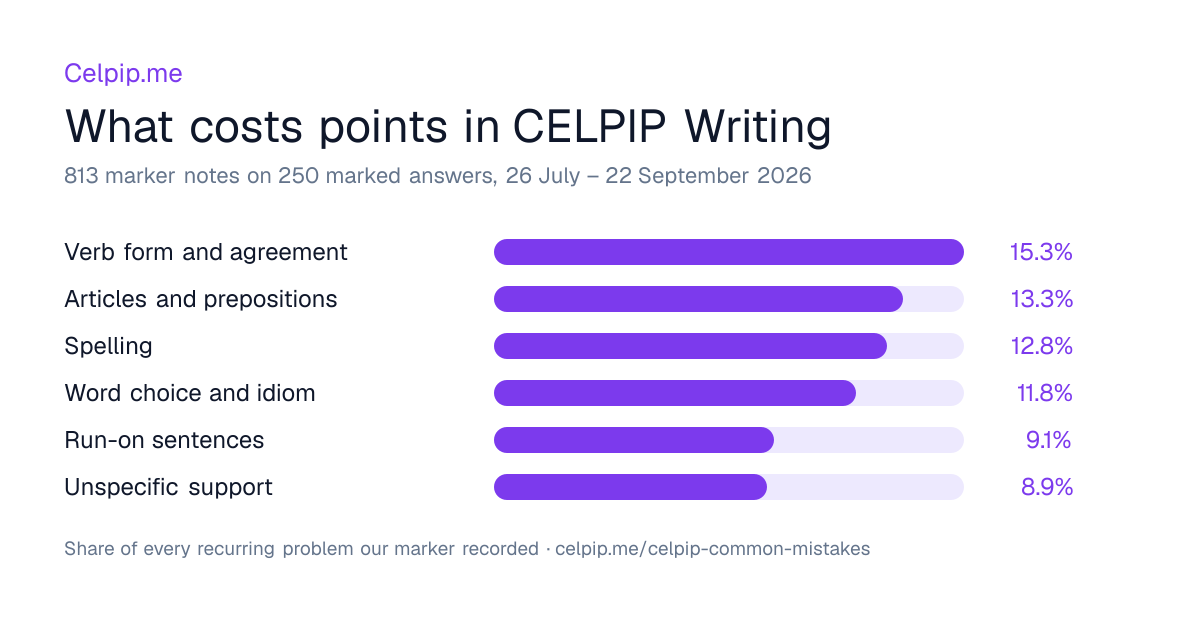
Verb form and agreement
15.3%The wrong tense, a missing auxiliary, or a subject and verb that do not match — “every staffs are”, “would be appreciate”.
Articles and prepositions
13.3%A missing or wrong a / an / the, or the wrong preposition inside a fixed phrase — “concerned for the delay”.
Spelling
12.8%Ordinary misspellings, most often in exactly the longer words the writer reached for on purpose.
Word choice and idiom
11.8%A real word used imprecisely, or a pairing no one says. The meaning survives; the score does not.
Run-on sentences
9.1%Two complete sentences joined by a comma, or a paragraph that never stops for a full stop.
Unspecific support
8.9%The reason is stated but never made concrete — no date, number, name or example behind it.
Capitalisation
7.3%A lower-case “i”, an uncapitalised proper noun, or a sentence that starts small.
Missing task content
5.0%One required content point left out — often the option you were meant to turn down.
Repetition instead of development
4.9%The same idea returns in new clothes instead of a new idea arriving.
Transitions and connectors
4.8%No signposting at all, or the same three connectors doing all of the work.
Sentence fragments
3.4%A clause standing on its own without a subject or a main verb.
The four largest categories — verb forms, articles and prepositions, spelling, word choice — come to 53.2% of every note. Not one of them is about what the writer had to say. The ideas arrive; the sentences carrying them are what gets marked down.
Counted a second way, answer by answer, the same thing shows up: readability was the single lowest of the four criteria in 52% at CLB 5, 52% at CLB 6, 62% at CLB 7, 48% at CLB 8 and 49% at CLB 9 — a majority at the level most Express Entry candidates are aiming past.
Speaking: what the marker flagged
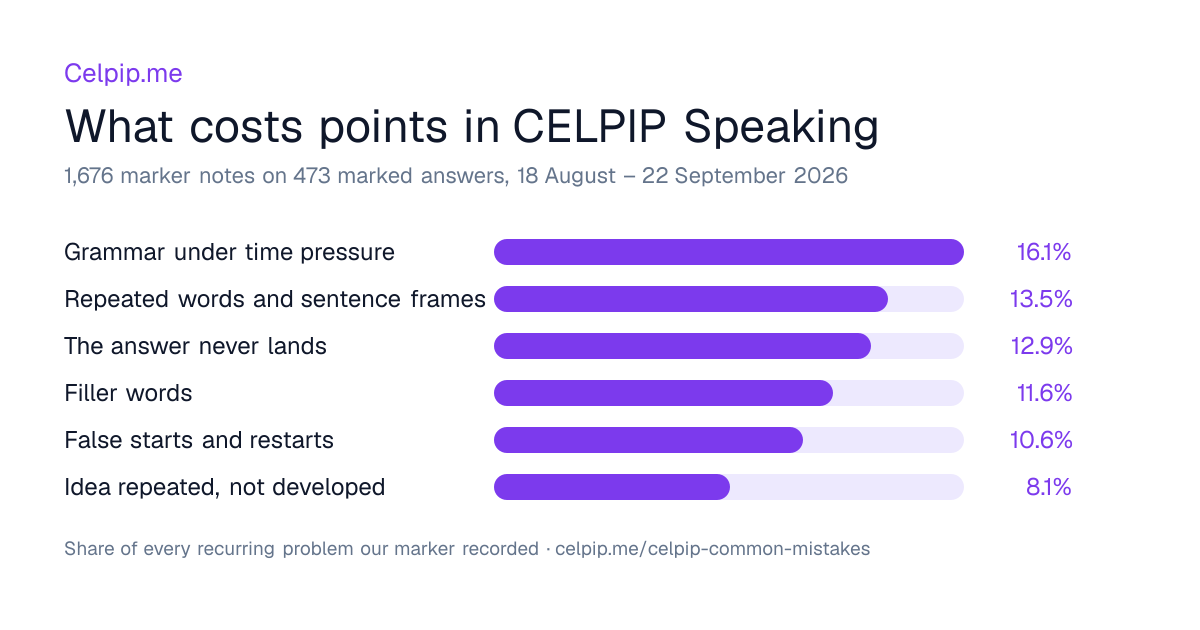
Grammar under time pressure
16.1%The same articles, prepositions, tenses and agreement as in Writing — with no chance to go back and fix them.
Repeated words and sentence frames
13.5%One handful of words and one sentence shape carrying the entire answer.
The answer never lands
12.9%The recording stops mid-sentence, or simply stops, with no closing line at all.
Filler words
11.6%“Uh”, “um”, “like”, “you know” — often enough that the marker counts them against fluency.
False starts and restarts
10.6%A sentence begun, abandoned and begun again, usually while hunting for one word.
Idea repeated, not developed
8.1%The same point made twice in different words instead of a second point arriving.
Underdeveloped content
6.1%Reasons listed but never explained, with no example behind any of them.
Weak organisation
6.0%No sequence a listener can follow, or one connector doing all the signposting.
Pauses and pacing
4.8%Long silences, or a rate so slow the answer never fills the time it was given.
Grouped, the picture is stark. Fluency problems — fillers, false starts, pauses — are 27.0% of all notes. Vocabulary problems, counting repeated words, imprecise choices and a narrow range together, are 18.2%. Between them, nearly half of everything the marker noticed, and neither has anything to do with whether the speaker had something to say.
The one worth reading twice is third on the list. In 12.9% of cases the problem is simply that the answer stopped — mid-sentence, or with no closing line. One problem in eight is running out of time, which is a habit rather than a level of English, and the cheapest thing on this page to fix.
Vocabulary also tightens as the score rises: it was the single lowest criterion in 40% at CLB 6, 41% at CLB 7, 58% at CLB 8 and 92% at CLB 9 — though CLB 9 is only six answers, so read that last one as a direction, not a number.
Speaking pace rises with the score
Writing length famously does not separate the bands — our score data page shows longer emails do not score higher. Speaking behaves the opposite way. Because the clock is part of the task, hesitation gets measured whether or not anyone intends it to be.
| Band | Answers | Median words | Median pace |
|---|---|---|---|
| CLB 5 | 68 | 120 | 57 wpm |
| CLB 6 | 180 | 139 | 68 wpm |
| CLB 7 | 168 | 156 | 76 wpm |
| CLB 8 | 51 | 165 | 83 wpm |
| CLB 9 | 6 | 221 | 104 wpm |
Median pace nearly doubles between CLB 5 and CLB 9, and the amount said in the same 60 or 90 seconds almost does too. Practising until you stop searching mid-sentence is worth more than practising new content — and it is the same fix as the unfinished answers above.
Both start here: timing and pacing drills and buying time gracefully.
Frequently asked questions
What is the most common mistake in CELPIP Writing?
Verb form and agreement — the wrong tense, a missing auxiliary, or a subject and verb that do not match. It accounts for 15.3% of every recurring problem our marker recorded across 250 marked Writing answers, ahead of articles and prepositions (13.3%) and spelling (12.8%).
What do CELPIP Speaking answers lose marks for?
Across 473 marked Speaking answers, fluency problems — filler words, false starts and long pauses — are 27.0% of everything flagged, and vocabulary problems 18.2%. A further 12.9% are answers that simply stopped: they ended mid-sentence or had no closing line, which is a timing habit rather than an English problem.
Are CELPIP mistakes mostly about grammar or about ideas?
Grammar and word choice, by a distance. In Writing, the four largest categories — verb forms, articles and prepositions, spelling, and word choice — are 53.2% of everything the marker flagged, and none of them is about what the writer had to say. Content problems such as unspecific support and missing task points together account for far less.
Which CELPIP criterion holds people back most?
In Writing it is readability: it was the single lowest of the four official criteria in 48–62% of marked answers at every level from CLB 5 to CLB 9. In Speaking it is vocabulary, and its share grows as the score rises — 40% at CLB 6, 58% at CLB 8.
Is this data from the official CELPIP test?
No. These are practice answers submitted on Celpip.me and marked by our AI on the four criteria CELPIP publishes. They show where practice answers lose points; they are not official results, and Paragon Testing Enterprises has no connection to them.
Related: writing & speaking score data · reading & listening data · CELPIP Writing · CELPIP Speaking.
Citing these numbers
Please do. Everything on this page is published under CC BY 4.0, which asks only for attribution. A line you can paste:
Celpip.me (2026). The mistakes that actually cost CELPIP points. 813 marker notes on 250 Writing and 1,676 on 473 Speaking answers. https://celpip.me/celpip-common-mistakes
The underlying score aggregate is open as JSON at /api/public/score-stats, under the same licence. If you are writing something and want a figure cut a different way, ask us at [email protected] — we would rather you had the real number than an estimate.
Find out which of these is yours
Write or speak one answer and get it marked on content, vocabulary, readability and task fulfilment — with the exact sentences that held each one down.
Start practising free →