
CELPIP Speaking Task 4 · Making Predictions · question 50 of 60
The Last Pieces of the Puzzle
A CELPIP Speaking Task 4 practice question (Making Predictions), with a model answer below. No sign-up needed. Read the task, take 30 seconds to prepare, then speak for 60 seconds, out loud, as you would on the test.
The task
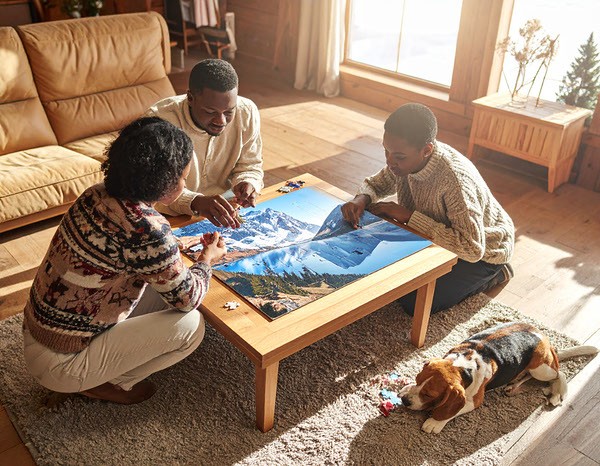
In this picture, what do you think will most probably happen next?
- Look at the picture, prepare during the preparation time, then say aloud what you think will most probably happen next.
- Preparation
- 30 seconds
- Speaking time
- 60 seconds
- Question
- 50 of 60
How to structure it
- Say how close the puzzle is to finished and who is still holding a piece.
- Use the pieces lying in front of the beagle's nose as the clue for a missing piece.
- Hedge what the dog has done, since its eyes are closed and you cannot see it chewing anything.
Model answer · CLB 7
124 words · no sign-upI can see three people in a living room. They are on the floor around a coffee table, and they are doing a big puzzle. The puzzle show mountains with snow and a blue lake, and it is almost finish. Two people is holding a piece. Next to the table, a dog is sleeping on carpet, and in front of his nose there is some pieces, blue and red. I think the people will put in the last pieces, but at the end one hole will stay in the puzzle. They will look on the table and in the box. Then somebody will see the dog and the pieces near him. Maybe the dog took them. They will laugh and finish the puzzle together.
Why this answer works
- Simple prediction in order: they finish, find a hole, search, and find the pieces by the dog.
- Real slips that do not block meaning: agreement ("The puzzle show", "Two people is holding", "there is some pieces"), a wrong form ("almost finish") and a missing article ("sleeping on carpet").
- Uses the key clue (the pieces near the dog) with a hedge ("Maybe"), but with simple words and little detail about the people.
Model answer · CLB 9
164 words · no sign-upThree people are gathered around a coffee table in a sunny living room, working on a big jigsaw puzzle of snowy mountains and a blue lake, and it looks almost finished. The man at the back and the person on the left are each holding a piece, and the person on the right is pressing pieces into place, so I think they are down to the last few. What catches my eye, though, is the beagle lying on the rug beside the table. Its eyes are closed, but right in front of its nose there are a few loose pieces, some blue and some red. My prediction is that they will put in the pieces they have and then realize that one spot is still empty. After checking the table and the box, someone will probably notice the dog. My guess is that the missing piece is in that little pile, maybe a bit damp, and they will finish the puzzle with a laugh.
Why this answer works
- Builds the prediction on visible clues: the pieces in their hands and the loose pieces in front of the beagle.
- Well organized, with a natural search sequence and a hedged conclusion.
- Hedges what cannot be seen ("so I think", "will probably notice", "My guess is that").
Model answer · CLB 11
170 words · no sign-upThis looks like the final few minutes of a very long puzzle, and I have a feeling the ending will involve the dog. The mountain lake on the coffee table is nearly complete: the man leaning in from the far side and the person crouching on the left each have a piece pinched between their fingers, while the person on the right is pressing the last ones flat. Now look down at the rug. The beagle is stretched out beside the table, eyes shut, as innocent as can be, and yet a little scatter of blue and red pieces is sitting right under its nose. That is hardly a coincidence. My prediction is that once the pieces in their hands go in, they will discover a gap, most likely in the sky or the lake, given that some of those strays are blue. A frantic search of laps and cushions will follow before someone finally thinks to look down, and I suspect the culprit will sleep through the whole investigation.
Why this answer works
- Organized around one idea, a final stretch that will involve the dog, from the last pieces to the search.
- Idiomatic, controlled language: "as innocent as can be", "That is hardly a coincidence", "sleep through the whole investigation".
- Varied structures and hedging ("I have a feeling", "most likely", "I suspect").
CLB levels are estimated. Not an official CELPIP score.
Get your own answer scored by AI: free account, no card
The model answer shows the target. To find out where your own recording lands, answer this question in the practice runner and get a CLB level for each criterion. A free account includes 10 AI-scored answers every 30 days.