
CELPIP Speaking Task 4 · Making Predictions · question 31 of 60
Stepping Stones Across the Creek
A CELPIP Speaking Task 4 practice question (Making Predictions), with a model answer below. No sign-up needed. Read the task, take 30 seconds to prepare, then speak for 60 seconds, out loud, as you would on the test.
The task
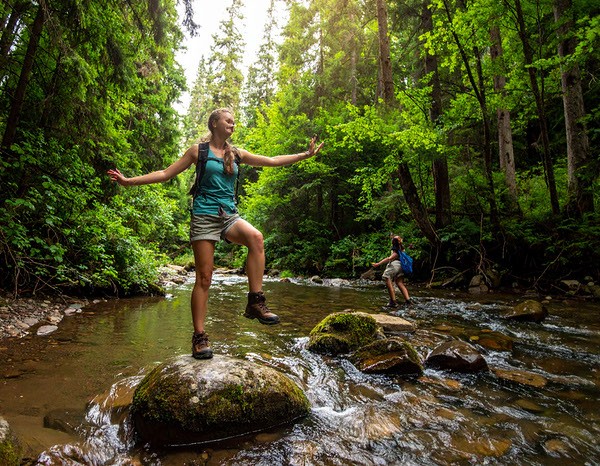
In this picture, what do you think will most probably happen next?
- Look at the picture, prepare during the preparation time, then say aloud what you think will most probably happen next.
- Preparation
- 30 seconds
- Speaking time
- 60 seconds
- Question
- 31 of 60
How to structure it
- Start with her stretched-out arms and lifted foot, because they show she is about to step.
- Use the wet, mossy rocks as the clue for a possible slip.
- Mention the second hiker standing in the water as a sign that the creek is shallow.
Model answer · CLB 7
123 words · no sign-upThere is a young woman in this picture who is crossing a creek in the forest. She stand on a big rock with moss, and her arms are open wide for the balance. One of her foot is up in the air, so I think she want to step to the next rock. The rocks look very wet and slippery. I think maybe she will slip and her boot will go into the water. Then her sock will be wet, but she will be okay, because the water is not much deep. Another hiker is behind her, and this person is already standing in the water. Maybe this hiker will help her or just laugh. After that, they will continue the hike together.
Why this answer works
- Simple prediction in a clear order: she steps, slips, gets a wet foot, and the hike continues.
- Real slips that do not block meaning: agreement ("She stand", "she want"), an extra article ("for the balance"), a plural error after one of ("One of her foot") and a wrong adverb ("not much deep" for not very deep).
- Uses the visible clues ("very wet and slippery", "already standing in the water") but with general vocabulary and little detail.
Model answer · CLB 9
144 words · no sign-upThis picture shows two hikers crossing a shallow creek in a thick green forest. The one in front, a young woman with a long braid, is balancing on a large mossy rock with her arms stretched out and one foot lifted, so she is probably about to step onto the next stone. What worries me is that the rocks look wet and are covered in moss, which usually makes them very slippery. I think the most likely outcome is that she will wobble for a second and her lifted boot will land in the water instead of on the rock. Fortunately, the creek does not look deep, because the other hiker farther back is standing right in it, so she will probably just get a wet foot. After a laugh, she will likely keep going and reach the far bank without any real trouble.
Why this answer works
- Builds the prediction on visible clues: the lifted foot, the mossy rocks and the second hiker in the water.
- Well organized and accurate, moving from the risk ("What worries me") to the most likely result and the ending.
- Hedges the uncertain parts ("probably about to step", "the most likely outcome", "will likely keep going").
Model answer · CLB 11
153 words · no sign-upWhat I see here is a balancing act that could go either way. The hiker in the foreground has stopped on a moss-covered boulder in the middle of a fast little creek, arms flung out like a tightrope walker and one boot hovering in mid-air, which tells me she is judging the gap to the next stone. The trouble is that moss and wet rock are a notoriously bad combination, so my prediction is that her foot will skid on landing and she will end up ankle-deep in the current. That said, I do not expect anything serious. The second hiker, who is wading a little farther back, suggests the water is fairly shallow, so the worst case is probably a soaked boot and a damp sock for the rest of the trail. Most likely, the two of them will laugh it off, wring out the sock, and carry on through the forest.
Why this answer works
- Organized around one idea, a balancing act that could go either way, with a clear worst case and likely ending.
- Precise, idiomatic language used naturally: "arms flung out like a tightrope walker", "a notoriously bad combination", "laugh it off".
- Varied structures and hedging ("which tells me", "That said", "suggests the water is fairly shallow", "Most likely").
CLB levels are estimated. Not an official CELPIP score.
Get your own answer scored by AI: free account, no card
The model answer shows the target. To find out where your own recording lands, answer this question in the practice runner and get a CLB level for each criterion. A free account includes 10 AI-scored answers every 30 days.