
CELPIP Speaking Task 8 · Describing an Unusual Situation · question 42 of 60
Ducklings Following a Dog
A CELPIP Speaking Task 8 practice question (Describing an Unusual Situation), with a model answer below. No sign-up needed. Read the task, take 30 seconds to prepare, then speak for 60 seconds, out loud, as you would on the test.
The task
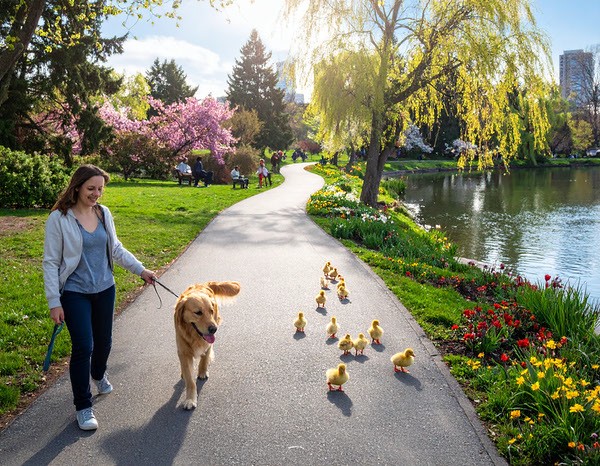
You are sitting on a bench in a city park when you notice something unusual coming along the path. Your nephew loves animals and is doing a school project about them, but you are afraid that if you move to take out your phone, the ducklings will get scared. Phone your nephew. Provide a full and clear description of what you see and ask what he thinks the ducklings are doing.
- Look at the picture, prepare during the preparation time, then describe it aloud for the speaking time.
- Preparation
- 30 seconds
- Speaking time
- 60 seconds
- Question
- 42 of 60
How to structure it
- Describe the dog and its owner first, then the line of ducklings behind them.
- Give an approximate number for the ducklings rather than an exact one.
- End by asking your nephew for his opinion, since he is studying animals.
Model answer · CLB 7
128 words · no sign-upHi, it is me. I am in the park, sitting on the bench, and something very funny is happening. A woman is walking her dog on the path. The dog is a golden retriever, and it look very happy, with the tongue out. Behind the dog there is many small yellow ducklings, maybe ten or twelve. They walks on the path the same way like the dog. I think they are following it! The woman have long brown hair and a grey sweater, and she is smiling. Next to the path there is a pond with a big tree and red and yellow flowers. I don't move, because I don't want to scare them. You know a lot about animals. What do you think the ducklings are doing?
Why this answer works
- Describes the dog and the woman, then the ducklings and the park, and ends with the question the task asks for.
- Real slips that do not block meaning: agreement ("it look very happy", "there is many small yellow ducklings", "They walks", "The woman have") and a comparison form ("the same way like the dog").
- Simple vocabulary ("very funny", "a big tree") with a hedged number and guess ("maybe ten or twelve", "I think they are following it"); the blossoms and the building are left out.
Model answer · CLB 9
158 words · no sign-upHi, it's me. I'm sitting on a bench in the park, and I'm watching something perfect for your animal project. A woman is walking a golden retriever on a leash along the path, and right behind the dog, a little to one side, there's a line of tiny yellow ducklings, about a dozen of them, all heading in the same direction. It honestly looks as if they're following the dog. The dog seems very relaxed, with its mouth open and its tongue hanging out, and the woman, who has long brown hair and a grey cardigan, is smiling about it. Next to the path, there's a pond with a weeping willow and beds of red and yellow tulips, and farther away there are trees with pink blossoms. I'm staying still because I don't want to scare the ducklings by reaching for my phone. You know a lot about animals. So what do you think those ducklings are doing?
Why this answer works
- Starts with the main action, then adds details about the dog, the woman and the park.
- Accurate and natural, with precise detail: "a weeping willow", "beds of red and yellow tulips".
- Hedges its reading of the scene ("It honestly looks as if they're following the dog", "seems very relaxed") and ends with a clear question.
Model answer · CLB 11
166 words · no sign-upHere's a puzzle for your animal project. I'm on a bench in the park, and coming down the path toward me is a woman walking a golden retriever on a leash, which sounds ordinary until you notice the parade behind them. Trailing just behind the dog, slightly off to one side, is a little procession of yellow ducklings, roughly a dozen, waddling along in the same direction as if the dog were their leader. The retriever doesn't seem bothered in the slightest; it's padding along with its tongue lolling out, and the woman, long brown hair, grey cardigan, can't stop smiling. The setting is almost too pretty to be real: a pond on the right with a weeping willow trailing into it, tulip beds in red and yellow, and pink blossom trees off in the distance. I'm sitting completely still, because one wrong move and they'll scatter. So, as our resident animal expert, what do you think is going on? Why would ducklings follow a dog?
Why this answer works
- Frames the call as "a puzzle for your animal project" and ends by asking the listener to solve it.
- Precise, idiomatic language: "the parade behind them", "a little procession of yellow ducklings", "one wrong move and they'll scatter".
- Hedges its numbers and inferences ("roughly a dozen", "as if the dog were their leader", "doesn't seem bothered") and closes with a natural question.
CLB levels are estimated. Not an official CELPIP score.
Get your own answer scored by AI: free account, no card
The model answer shows the target. To find out where your own recording lands, answer this question in the practice runner and get a CLB level for each criterion. A free account includes 10 AI-scored answers every 30 days.