
CELPIP Speaking Task 8 · Describing an Unusual Situation · question 47 of 60
A Horse at the Bike Rack
A CELPIP Speaking Task 8 practice question (Describing an Unusual Situation), with a model answer below. No sign-up needed. Read the task, take 30 seconds to prepare, then speak for 60 seconds, out loud, as you would on the test.
The task
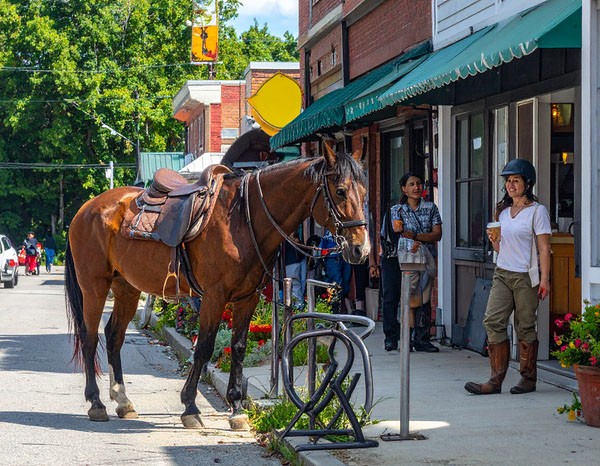
You are buying a coffee on the main street of a small town when you notice something very unusual parked outside the shops. Your cousin has ridden horses since childhood, but you dropped your phone this morning, and the camera lens is cracked, so every picture comes out blurry. Phone your cousin. Provide a full and clear description of what you see and ask whether your cousin would ever ride a horse into town to run errands.
- Look at the picture, prepare during the preparation time, then describe it aloud for the speaking time.
- Preparation
- 30 seconds
- Speaking time
- 60 seconds
- Question
- 47 of 60
How to structure it
- Say where the horse is standing compared with the bike rack and the curb.
- Describe the rider's clothes, because the helmet and boots explain who the horse belongs to.
- If you cannot see whether the horse is tied, say so instead of guessing.
Model answer · CLB 7
131 words · no sign-upHey, it is me. I am in the small town for a coffee. There is a horse parked at the bike rack! It is a brown horse with a saddle, and it stand in the road next to the rack. I don't know if somebody tie it or not. On the sidewalk there is a woman with a black riding helmet, white T-shirt and long brown boots. She have a coffee cup in her hand and she is smiling, so I think the horse is her. Another woman with a cup is watching her. The shops have green roofs over the door and there is flowers. My camera is broken, so my pictures are all blurry. You ride horses all the time. Would you ever ride horse to town for shopping?
Why this answer works
- Describes the horse, the rider and the street, and ends with the question the task asks for.
- Real slips that do not block meaning: agreement ("it stand in the road", "She have a coffee cup", "there is flowers"), a verb form ("if somebody tie it"), a wrong pronoun ("the horse is her") and a missing article ("ride horse to town").
- Simple wording ("green roofs over the door" for awnings) with one hedge ("I think"); the flowerpots and the brick buildings are left out.
Model answer · CLB 9
168 words · no sign-upGuess where I am. I'm standing on the main street with a coffee, and there's a horse parked at the bike rack. I'm serious. It's a tall brown horse with a leather saddle, standing in the road right beside an empty bike rack at the curb, and its reins hang from its head back toward the saddle. I honestly can't tell whether it's tied to anything. On the sidewalk, a woman in a black riding helmet, a white T-shirt, khaki pants and tall brown riding boots is holding a takeout cup and smiling, so I'm pretty sure she's the rider and she just popped in for a drink. Another woman in a patterned shirt, also holding a cup, is watching her. The shops have green awnings and flowers out front, so the whole thing looks like a postcard. My camera lens is cracked, so a picture would just be a blur. You've ridden all your life, so tell me: would you ever ride into town to run errands?
Why this answer works
- Gives the surprise first, then the horse, the rider and the street in a clear order.
- Accurate and natural, with careful detail and an honest limit: "I honestly can't tell whether it's tied to anything".
- Hedges its inference about the rider ("I'm pretty sure she's the rider") and ends with the question the task asks for.
Model answer · CLB 11
175 words · no sign-upYou'd love this, because I've just found a new kind of drive-through. I'm on the main street here, coffee in hand, and parked at the bike rack, of all places, is a saddled brown horse. It's standing in the road with its front hooves almost touching the curb, right next to the rack, as patient as you like, with its reins draped from its bridle back to the saddle. Whether anyone actually tied it up, I can't tell from here. The rider isn't hard to spot: a woman in a black riding helmet, a white tee, khaki pants and knee-high brown boots, strolling along the sidewalk with a takeout cup and a big grin. A second woman, also clutching a cup, is watching the whole thing with interest. Add the green awnings and the flowers along the curb, and it feels like a scene from another century. My lens is cracked, so photos are hopeless. So, as someone who practically grew up in a saddle, would you ever ride into town to run your errands?
Why this answer works
- Organizes the call around one playful idea, a new kind of drive-through, and moves from the horse to the rider to the setting.
- Idiomatic, varied structures: "parked at the bike rack, of all places", "as patient as you like", "Whether anyone actually tied it up, I can't tell".
- Treats the rider as an inference from visible clues (helmet, boots, grin) and closes with a personal version of the task's question.
CLB levels are estimated. Not an official CELPIP score.
Get your own answer scored by AI: free account, no card
The model answer shows the target. To find out where your own recording lands, answer this question in the practice runner and get a CLB level for each criterion. A free account includes 10 AI-scored answers every 30 days.